
July 10, 2026
If you’ve got a massive maple, oak, or pine looming over your Southwestern Ontario home, and lately you’ve started noticing things you didn’t notice before – a few mushrooms at the base, some bigger dead branches up top, maybe a lean that wasn’t quite so pronounced last summer – you’ve probably already started to worry. Large decaying trees near a house are one of those situations that nobody wants to think about until they have to, and then suddenly it’s all you can think about. The tree was a feature of the property for decades. Now it’s a problem, and the longer you leave it, the bigger the problem gets.
At Sharpe Tree Service, we’ve been removing large hazardous trees across Southwestern Ontario for eighteen years, and over that time we’ve fielded the same questions from homeowners over and over. How dangerous is the tree actually? Can it wait until spring? How do you even get a tree like that down without putting it through the roof in the process? And the big one – what’s this going to cost?
This guide walks through all of it. By the end of it you’ll know how to recognize when a tree near your house has crossed the line from “keep an eye on it” to “deal with it now,” what’s actually involved in removing one of these trees safely, and what to expect when a crew shows up to do the work.
Let’s get into it.
How Bad Is It, Really? Reading the Warning Signs
The good news, if there is any, is that most large trees give you plenty of warning before they fail. The bad news is that those warning signs aren’t always obvious to someone who hasn’t seen a few hundred trees come apart. Here’s what we look at when we walk a property to evaluate a questionable tree near a structure.
Start With the Base
Start with the base. The bottom three or four feet of trunk and the soil right around it tell you more about a tree’s condition than the rest of the tree combined.
Warning signs include:
- Mushrooms or shelf-like conks growing on the trunk
- Fungal growth sprouting from the ground around the base
- Hollow-sounding wood when tapped
- Deep vertical cracks running up the trunk
Mushrooms or shelf-like conks growing on the trunk or sprouting out of the ground at the base mean a wood-decay fungus is already at work inside the tree. By the time you can see the mushroom, the fungus itself has usually been eating the wood for years – sometimes a decade or more.
Hollow-sounding wood when you tap firmly with the back of a hatchet is another red flag. A healthy hardwood gives back a solid thunk; a tree with significant interior decay sounds dull, drum-like, almost empty. Deep vertical cracks running up the trunk, especially cracks you can fit a finger into, point to structural failure already in progress.
Check the Lean
Now look at the lean. Every tree has a slight natural lean, and most have grown that way since they were saplings, so a lean by itself doesn’t mean trouble.
What does mean trouble is:
- A lean that’s gotten noticeably worse
- Cracked or heaving soil around the base
- Roots lifting out of the ground
- Visible movement in the root plate
If the tree was nearly vertical five years ago and you can now clearly see it’s tilted toward the house, the root system is failing and the lean is the visible part of the process. Watch for cracked or heaving soil on one side of the base, or roots that have started lifting out of the ground on the side opposite the lean. Both mean the root plate is moving, and a moving root plate is the precursor to a full uproot.
Look Up Into the Canopy
Then look up. Step back thirty or forty feet from the tree so you can see the whole canopy at once, and check for dead branches.
Pay attention to:
- Large dead limbs
- Brown or bare sections of the canopy
- Uneven foliage
- Significant canopy dieback
A few small dead twigs are normal on any mature tree. What you don’t want to see is large dead limbs, especially up high, or whole sections of the canopy that have gone brown or bare while the rest of the tree is full and green.
As a rough rule, when more than about a quarter of a tree’s canopy is dead, the tree is on a one-way trip. The dead parts won’t come back, and they typically signal something larger going on – root damage, internal decay, a pest infestation that’s already done significant harm.
Consider the Target
Finally, look at where the tree is in relation to your house. A tree leaning over open lawn is a different problem than the same tree leaning over a roof.
Ask yourself:
- Would the canopy come down across a structure?
- Would major limbs land on the roof?
- Is the trunk pointed at a bedroom?
Those questions are uncomfortable, but they’re the ones that matter when you’re deciding whether to remove a compromised tree or take your chances.
Any one of these warning signs on a tree near your house is worth a professional look. Two or three of them together means the tree needs to come down soon, not eventually.
Why These Removals Are Different from Routine Tree Work
Removing a healthy tree in an open field is straightforward work. The wood is sound, you can climb the tree safely, you can predict how it’ll behave when cuts are made, and there’s room to drop sections wherever’s convenient. Removing a large decaying tree leaning toward someone’s home is the opposite of all of those things, and it’s one of the most demanding jobs in the tree care industry.
The wood can’t be trusted. Interior decay means the trunk and major limbs may not hold a climber’s weight, may not hold the load of rigged sections being lowered, and may not behave the way the climber expects when a cut is made. The traditional sectional removal approach – where a climber works up the tree and takes it apart piece by piece, lowering each section with ropes – depends on the assumption that the climbing path and the rigging points are sound. When the wood is compromised, that assumption is the first thing to go, and what’s left is a climber working a tree that might give way underneath them without warning.
There’s no margin for error with the house directly underneath. On a standard removal in an open yard, if a section comes down a few feet to one side of where it was supposed to, the worst that happens is a divot in the lawn. On a decaying tree leaning over a roof, the same few feet is the difference between a clean job and an insurance claim that runs into five figures. Tight access makes everything harder still – most large trees near houses are hemmed in by the structure itself, by fences, by the neighbour’s property, by sheds and outbuildings and landscaping that limit where pieces can be safely dropped.
This is the situation cranes were made for, and on most large decaying tree removals near a structure, a crane isn’t just the safer option – it’s really the only sensible one.
How Crane-Assisted Removal Actually Works
Bringing in a crane changes the whole approach. Instead of asking a compromised tree to hold a climber and the weight of rigged sections, the crane does the holding, and the tree just has to stay where it is long enough to be cut apart.
The crane gets positioned where its boom can reach the entire tree, which usually means setting up on the driveway, on the street, or sometimes on a neighbour’s property with their permission. Once the crane is in place, the operator and the lead climber work together to plan each pick before the climber goes anywhere near the tree. They figure out where to attach the hook, where to make the cut, where the piece is going to be set down, and what the sequence is going to be. Good crane work is mostly planning. The actual cutting is the easy part.
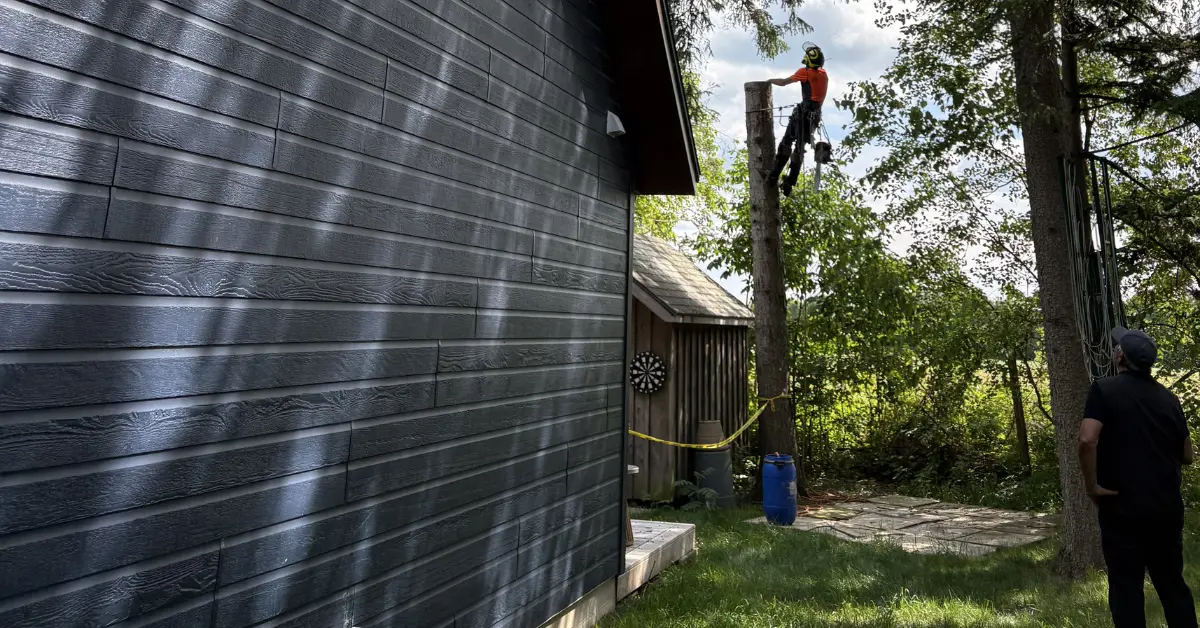
For each section, the climber attaches the crane’s hook above the cut, the cut is made, and the crane lifts the section cleanly away from the tree and sets it down in a designated drop zone – usually the front yard or the street, well clear of the house. Nothing falls through the canopy. Nothing drops onto the roof. Each piece goes exactly where the crane operator wants it. Working down the tree this way, the climber gradually reduces the decaying structure to nothing, picking off the upper canopy first, then the major laterals, then the trunk in sections, until what’s left is a stump ready for grinding.
The work is slower than a fast climbing-and-rigging job, and it’s significantly more expensive because the crane itself costs real money. But for the right tree – a large hazardous specimen leaning over a house – there’s no comparable approach in terms of safety, and the protection of the structure is the whole point of the job.
What This Kind of Work Costs
Let’s talk money. Large decaying tree removals near a structure are not cheap, and anyone who quotes you a suspiciously low price over the phone without seeing the tree is either lowballing to get the job and planning to bill you more later, or they don’t know what they’re getting into. In Southwestern Ontario, a standard residential large-tree removal without crane work typically runs somewhere between $1,500 and $5,000. A large decaying tree near a structure, with crane-assisted removal, usually runs $3,000 to $10,000, depending on the size of the tree and site access difficulty.
The biggest single line item is usually the crane itself. A crane and operator typically runs $1,500 to $3,500 for a residential job, sometimes more if the work spans multiple days. That’s not a markup we add – it’s what the equipment actually costs, and it’s the reason this kind of removal isn’t priced like a routine job. The good news is that for a tree that needs the crane treatment, that crane cost is usually money well spent, because it’s protecting tens of thousands of dollars in roof, structural, and interior repairs that would otherwise be on the table.
The only way to get a real number for any specific tree is a free on-site quote. We come out, walk the property, evaluate the tree’s condition and the access, and put a firm price in writing, locked in by our no-surprise guarantee. The quote you sign is the price you pay at the end of the job, even if the work turns out to be harder than we expected.
A Few Things Not to Do
Three quick warnings worth taking seriously when you’ve identified a tree that needs to come down near your house.
Don’t put it off. Decaying trees don’t get better. They get worse, usually slowly at first and then more quickly, and the longer you wait, the higher the chance the tree decides the timing for you. The cost of removing the tree is essentially the same whether you do it this fall or next spring – but the risk of property damage between now and then keeps climbing. We’ve responded to plenty of jobs that became emergency calls because the homeowner waited one season too long, and emergency rates run higher than scheduled work.
Don’t hire someone who knocks on your door offering immediate cheap cleanup. After every major storm across Southwestern Ontario, traveling crews appear in every small town offering tree work at prices that seem impossible to pass up. Some of those crews are legitimate. Many are not. Uninsured operators, no business address, no licence, and gone the day after they cash your cheque. If you have a hazardous tree near the house, get someone in writing, get proof of insurance, and verify the business is real before any saw runs.
Don’t try to take it down yourself. A small healthy backyard tree, removed by an experienced homeowner with a chainsaw on a calm Saturday afternoon, is sometimes a reasonable do-it-yourself project. A large decaying tree leaning over the house is not. There’s no version of this job that’s safe without proper equipment, proper training, and proper insurance, and the people who get hurt trying are almost always confident chainsaw users who didn’t realize what they were getting into until it was too late.
Why Sharpe Tree Service?
We do the job right, we don’t cut corners, and we treat your property like it’s our own. Large hazardous tree removal is dangerous work, and the crews that handle it well aren’t the cheapest in town and they’re not the ones who can come out tomorrow. They’re the ones with the right gear, the right training, and the patience to take a hundred-year-old decaying tree down piece by piece without leaving a mark on the house underneath.
Ready to Get Started?
If you’ve got a large decaying tree on your Southwestern Ontario property that needs to come down, the next step is straightforward. Call Sharpe Tree Service at (226) 271-8969 for a free, no-pressure quote.. We’ll come out, take a look at the tree and the access, give you a straight answer about what the job involves and what it’ll cost, and let you decide from there. References available, weekend appointments by request, and a 24/7 emergency line if the situation has already moved past the planning stage.


